Insurance Coverage, Authorization, and How It Differs From a Tummy Tuck
A panniculectomy removes the pannus, the apron of excess skin and tissue that hangs over the lower abdomen after major weight loss. When that overhanging skin causes chronic rashes, infections, or gets in the way of daily life, it can be treated as a medical problem rather than a cosmetic one, and insurance may help cover it.
At West Medical, panniculectomy is performed by Dr. Farzin Kerendian, D.O., FACOS, a board-certified cosmetic and reconstructive surgeon.
This is the distinction that decides whether your insurance pays, and it confuses almost everyone. The two procedures overlap, but they are not the same operation and insurers treat them very differently.
| Panniculectomy | Abdominoplasty (tummy tuck) | |
|---|---|---|
| What is removed | The overhanging apron of skin and tissue | Excess skin, plus contouring of the whole abdomen |
| Muscle repair | No | Yes, the abdominal muscles are tightened |
| Navel repositioned | No | Yes |
| Classified as | Can be reconstructive, with documentation | Cosmetic |
| Insurance | May be covered, depending on your plan | Depends on your plan and circumstances |
The short version: the muscle tightening and navel repositioning are exactly what make a tummy tuck cosmetic. A panniculectomy leaves those out, which is why it can qualify as reconstructive. Many patients choose to have both, and we structure the plan around what your insurance allows.
It can, depending on your plan. Every insurer sets its own criteria, and no two plans are exactly alike, so there is no single checklist that applies to everyone.
What is consistent across insurers is documentation. Before authorizing surgery, your plan will want records from a physician showing that the pannus is causing real medical problems, not just that you would prefer it gone. That paper trail, more than anything else, is what decides an authorization.
This is where West Medical does the heavy lifting. Our team obtains insurance authorizations every day for bariatric surgery, and we know what documentation plans ask for and how to present it. Your job is to report the problem to a physician. Ours is to turn that record into an authorization.
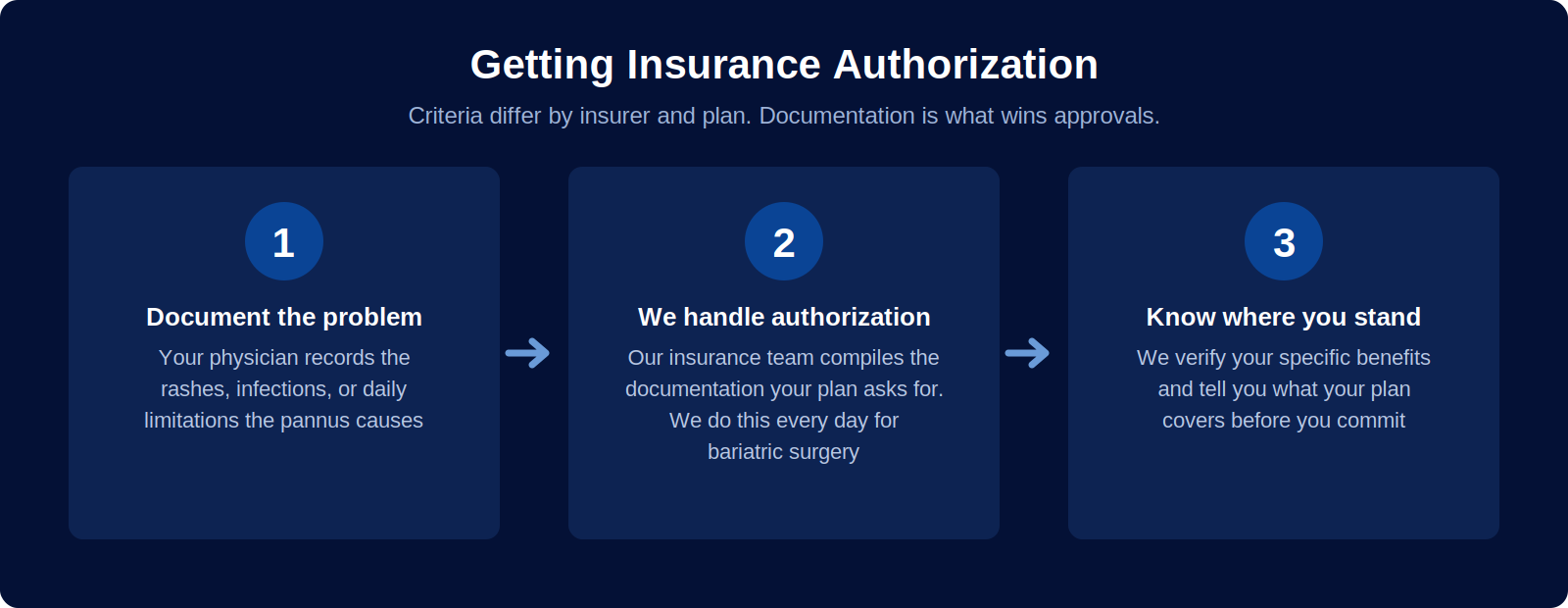
If you are a bariatric patient and you already suspect you will want this eventually, the single most useful thing you can do is make sure the problem is in your medical record. That means reporting rashes and skin infections under the fold to your physician when they happen, following whatever treatment is prescribed, and having those visits documented. Approvals are usually won or lost on the paper trail, and a paper trail cannot be created retroactively.

You do not have to work this out on your own. The same West Medical team that verifies insurance benefits for bariatric surgery handles panniculectomy verification, so we can tell you what your plan requires and where you currently stand before you commit to anything. A consultation with Dr. Kerendian establishes whether you are a candidate clinically, and we run the coverage check alongside it.
Or call (888) 379-7633.