
Introduction to Partial Knee Replacement Surgery
Partial knee replacement surgery is a minimally invasive procedure that replaces only the damaged portion of the knee joint, preserving healthy bone and ligaments. It is typically recommended for patients with arthritis limited to one compartment of the knee and may offer faster recovery compared to total knee replacement.
Also known as partial knee arthroplasty or unicompartmental partial knee replacement, this approach focuses on restoring smooth movement while maintaining as much of your natural knee as possible. Because only the affected area is treated, many patients experience less postoperative discomfort and a more natural-feeling joint.
At West Medical’s comprehensive knee orthopedic care services, our specialists evaluate whether a partial knee replacement procedure or a full replacement is the better long-term solution. The right choice often depends on joint damage, activity level, and overall health.
If you’re researching partial vs full knee replacement, understanding candidacy, surgical technique, and realistic recovery expectations is essential. You can also explore practical guidance for protecting your joints before and after surgery in our expert knee care tips from our orthopedic specialists. In the sections below, we’ll break down benefits, recovery timelines, and what to expect from a partial knee operation.
In summary: Partial knee replacement surgery targets isolated knee damage, preserves healthy structures, and may allow a quicker return to daily activities compared to total knee replacement—when patients are appropriately selected.
Table of Contents
- What Is Partial Knee Replacement Surgery?
- Key Benefits of Partial Knee Replacement Surgery
- Partial vs Full Knee Replacement: What’s the Difference?
- How the Partial Knee Replacement Procedure Works
- Partial Knee Replacement Recovery Timeline
- Cost and Insurance Considerations in 2026
- Is Partial Knee Replacement Right for You?
- Frequently Asked Questions About Partial Knee Replacement Surgery
- Take the Next Step Toward Knee Pain Relief
What Is Partial Knee Replacement Surgery?
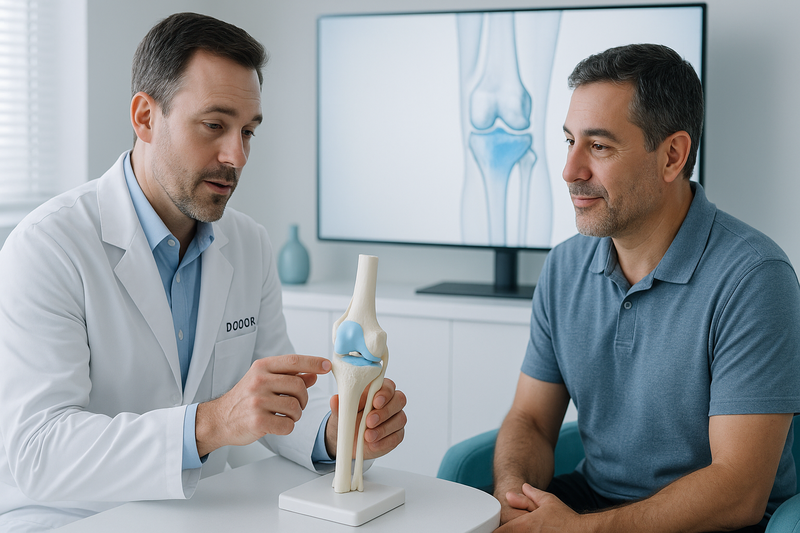
Partial knee replacement surgery is a procedure that replaces only the damaged portion of the knee joint while preserving healthy bone, cartilage, and ligaments. Also called partial knee arthroplasty or unicompartmental partial knee replacement, it is designed for patients with arthritis limited to one area of the knee.
Unlike total knee replacement, which resurfaces the entire joint, a partial knee replacement procedure focuses on the specific compartment affected by osteoarthritis or localized cartilage damage. By keeping the remaining joint structures intact, this approach often allows for more natural knee movement and may support a smoother partial knee replacement recovery.
Diagnosis typically involves physical examination, weight-bearing X-rays, and sometimes MRI through comprehensive orthopedic evaluation and imaging services to confirm that damage is confined to a single compartment.
Understanding the Three Knee Compartments
The knee joint has three main compartments. Arthritis confined to just one of these areas may qualify for a partial knee operation.
- Medial compartment — the inner part of the knee; most commonly affected by osteoarthritis.
- Lateral compartment — the outer portion of the knee.
- Patellofemoral compartment — where the kneecap (patella) meets the thigh bone.
If only one compartment shows significant cartilage loss while the others remain healthy, surgeons may recommend partial knee arthroplasty surgery instead of a full replacement.
Who Is a Candidate for Partial Knee Arthroplasty?
Candidacy depends on careful evaluation. In general, patients may be eligible if they meet most of the following criteria:
- Arthritis limited to a single knee compartment
- Intact and stable ligaments, especially the ACL
- Good range of motion with minimal stiffness
- No significant knee deformity
- Persistent pain despite conservative treatment
Patients with early-stage arthritis often begin with non-surgical strategies such as strengthening, bracing, or injections, as outlined in these knee care tips from an orthopedic specialist. When those options no longer provide relief and damage remains localized, partial knee replacement surgery may be considered.
In summary: Partial knee replacement surgery treats isolated compartment arthritis by resurfacing only the damaged area, preserving healthy structures and maintaining more natural joint mechanics compared to total knee replacement.
Key Benefits of Partial Knee Replacement Surgery
Partial knee replacement surgery offers targeted relief for patients with arthritis limited to one compartment of the knee. Compared to a total knee replacement, this focused approach preserves healthy structures and often allows for a smoother recovery. For many patients in California, it strikes the right balance between pain relief and joint preservation.
Less Invasive Than Total Knee Replacement
A partial knee arthroplasty treats only the damaged portion of the joint, leaving healthy bone, cartilage, and ligaments intact. In contrast, total knee replacement resurfaces the entire joint.
- Smaller incision with less soft tissue disruption
- Preservation of healthy bone and ligaments, including the ACL in many cases
- Reduced blood loss and lower overall surgical trauma
- Lower risk of stiffness compared to full joint replacement
Because the procedure is more precise and limited in scope, patients often experience less postoperative discomfort. Surgical planning is personalized through comprehensive knee orthopedic care, helping determine whether a partial vs full knee replacement is most appropriate.
Faster Recovery and More Natural Knee Movement
One of the most meaningful advantages of a partial knee replacement procedure is recovery speed. Because key ligaments and healthy joint surfaces remain in place, the knee can feel more stable and natural during movement.
- Shorter hospital stay, sometimes same-day discharge
- Earlier weight-bearing and walking with assistance
- Quicker return to daily activities compared to total knee replacement
- More natural joint mechanics due to preserved anatomy
The typical partial knee replacement recovery timeline varies, but many patients resume light activities within a few weeks, with continued improvement over several months. While outcomes depend on age, health, and rehabilitation, partial knee replacement vs full knee replacement comparisons consistently show faster early mobility for properly selected candidates.
In summary: Partial knee replacement surgery preserves healthy tissue, reduces surgical trauma, and often supports a quicker, more natural-feeling recovery than total knee replacement when arthritis is limited to one compartment.
Partial vs Full Knee Replacement: What’s the Difference?
When comparing partial knee replacement surgery to total knee replacement, the main difference is how much of the joint is replaced. A partial knee operation resurfaces only the damaged compartment, while a full replacement resurfaces the entire knee joint.
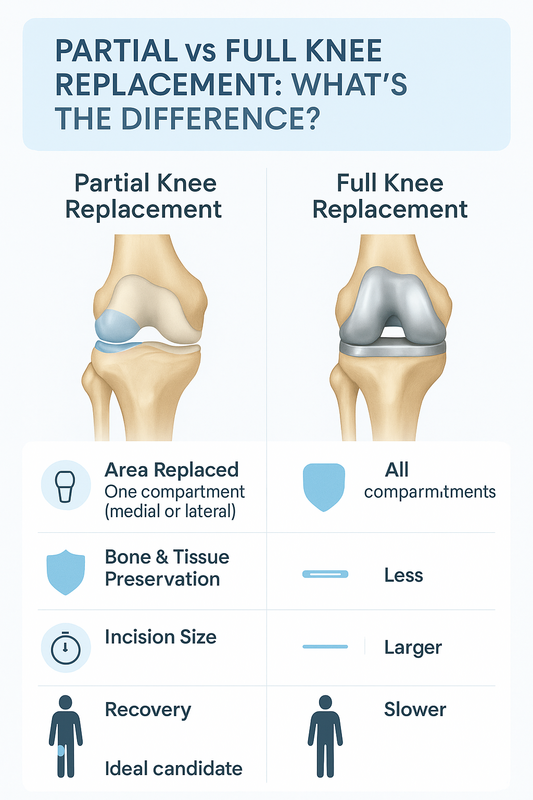
This infographic helps visualize the key differences between partial and full knee replacement procedures.
Understanding the distinction between partial vs full knee replacement can help you make a confident, informed decision. The right choice depends on the extent of arthritis, ligament health, activity level, and long-term goals.
- Area Replaced
Partial knee arthroplasty surgery: Replaces only one compartment (medial, lateral, or patellofemoral).
Total knee replacement: Replaces all three compartments of the knee. - Bone and Tissue Preservation
Unicompartmental partial knee replacement: Preserves more natural bone, cartilage, and ligaments.
Total knee replacement: Removes more bone and typically substitutes for damaged ligaments. - Incision Size & Surgical Impact
Partial knee replacement procedure: Usually smaller incision and less disruption to surrounding tissue.
Total knee replacement: Larger surgical exposure and more comprehensive joint resurfacing. - Recovery Experience
Partial knee replacement recovery: Often faster return to daily activities, with a shorter partial knee replacement recovery timeline for many patients.
Total knee replacement: Longer rehabilitation, especially in the early months. - Ideal Candidates
Partial knee arthroplasty: Best for patients with arthritis confined to one area and stable ligaments.
Total knee replacement: Recommended when arthritis affects multiple compartments or deformity is significant. - Cost Considerations
Costs can vary based on hospital fees, implant type, and insurance coverage. For a detailed breakdown of expenses, see this knee replacement surgery cost guide .
No single option is “better” for everyone. A thorough evaluation—including imaging, physical exam, and discussion of your lifestyle—is essential. At West Medical, patients are encouraged to seek a comprehensive assessment through advanced orthopedic care services before deciding between a partial knee replacement vs full knee replacement.
In summary: Partial knee replacement surgery treats localized damage and often allows quicker recovery, while full knee replacement addresses widespread arthritis and may offer broader long-term correction when the entire joint is affected.
How the Partial Knee Replacement Procedure Works
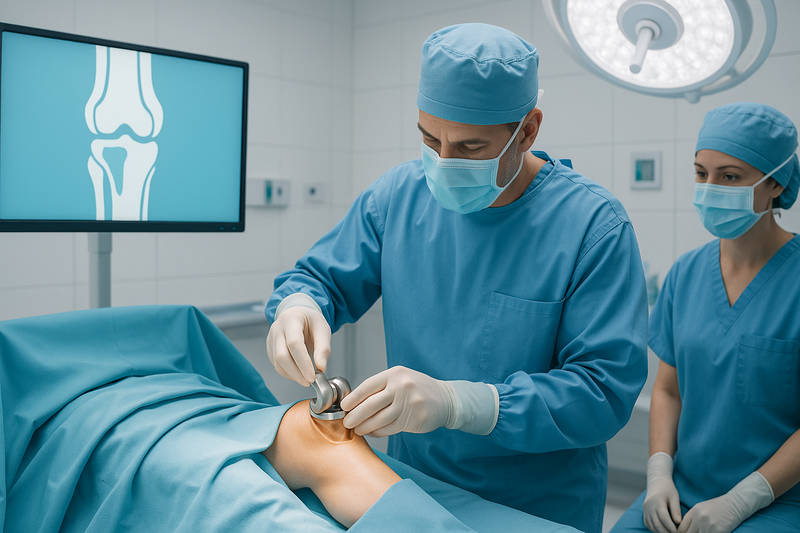
Understanding how partial knee replacement surgery works can ease anxiety and help you feel prepared. Also known as partial knee arthroplasty or a unicompartmental partial knee replacement, this procedure targets only the damaged portion of the knee while preserving healthy bone, cartilage, and ligaments.
Below is a clear, step-by-step overview—from consultation to early recovery—so you know exactly what to expect during the partial knee replacement procedure.
-
Step 1: Consultation and Diagnostic Imaging
Your journey begins with a comprehensive orthopedic evaluation. The surgeon reviews your symptoms, medical history, and prior treatments to determine whether partial knee replacement surgery is appropriate.
X-rays are typically used to confirm that arthritis is limited to one compartment of the knee. In some cases, an MRI may be ordered to assess cartilage and ligament integrity. If you’re a candidate, your surgeon will explain the benefits compared to partial knee replacement vs full knee replacement options and outline a personalized surgical plan.
-
Step 2: Implant Placement and Joint Preservation
On the day of your partial knee operation, anesthesia is administered for comfort. A small incision is made over the affected compartment, using minimally invasive techniques whenever possible.
The surgeon removes the damaged cartilage and a small amount of underlying bone. Healthy structures are preserved. Precision-shaped metal components are placed on the femur and tibia, with a smooth polyethylene insert between them to allow natural movement.
At West Medical’s knee orthopedic care program, advanced technology and specialized expertise help ensure accurate implant alignment and long-term stability.
-
Step 3: Immediate Post-Operative Recovery
After surgery, you are monitored in a recovery area while anesthesia wears off. Many patients stand and begin walking with assistance the same day, which supports circulation and joint mobility.
Because partial knee arthroplasty surgery preserves more of the natural knee, hospital stays are often shorter than with total knee replacement. Early movement and guided physical therapy play a key role in a smooth partial knee replacement recovery timeline.
In summary: partial knee replacement surgery involves confirming single-compartment damage, removing only the affected tissue, placing precisely fitted implants, and beginning early mobilization—often within hours of surgery.
Partial Knee Replacement Recovery Timeline
The partial knee replacement recovery timeline after partial knee replacement surgery is often faster than with total knee replacement. Because only the damaged compartment is treated, many patients regain mobility and return to daily activities sooner.
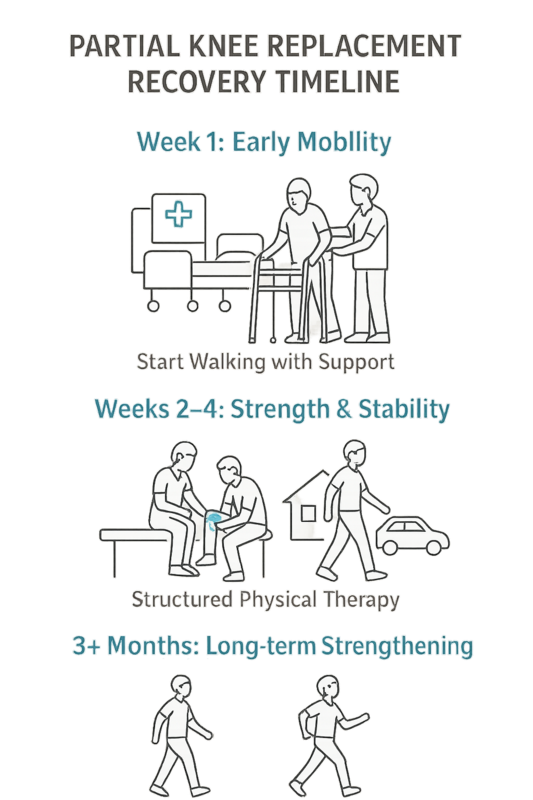
See each stage of partial knee replacement recovery at a glance.
Recovery varies by age, overall health, and commitment to rehabilitation. Below is a realistic, week-by-week overview to help you prepare for your partial knee replacement recovery.
- Week 1: Early Mobility and Pain Control — After a partial knee arthroplasty or unicompartmental partial knee replacement, most patients begin walking with assistance the same day or next day. Swelling and discomfort are common but typically manageable with medication, elevation, and ice. Gentle range-of-motion exercises start immediately.
- Weeks 2–4: Building Strength and Stability — Physical therapy becomes more structured. You’ll work on improving knee bend, straightening, and walking without assistive devices. Following expert home-care guidance, such as these knee care tips from a specialist, can help reduce stiffness and support safe progress.
- Weeks 6–8: Increasing Daily Activity — Many patients return to driving, light work, and low-impact exercise. Swelling continues to decrease, and strength improves. Your surgeon may clear you for activities like stationary cycling or swimming, depending on healing.
- 3 Months and Beyond: Long-Term Strengthening — By three months, most people experience significant pain relief and improved function compared to before their partial knee operation. Ongoing strengthening and balance training help protect the joint and extend the life of the implant.
Regular follow-up visits are essential to monitor healing and alignment. Scheduling appointments through comprehensive orthopedic care services ensures your recovery stays on track.
Quick Summary: Most patients walk within days, progress steadily over 6–8 weeks, and achieve strong functional recovery by three months after partial knee replacement surgery, with continued gains over time.
Cost and Insurance Considerations in 2026
The cost of partial knee replacement surgery in 2026 varies based on several medical and insurance factors. Because each case is unique, it’s important to understand what influences pricing before making a decision.
In California and across the U.S., total expenses for a partial knee arthroplasty may depend on:
- Hospital or surgical center fees
- Surgeon’s experience and specialization
- Anesthesia and implant type
- Pre-operative imaging and lab work
- Post-surgical physical therapy and follow-up visits
Insurance coverage for a partial knee replacement procedure is often similar to coverage for total knee replacement when it is deemed medically necessary. However, deductibles, copays, and network restrictions can significantly affect your out-of-pocket responsibility. Pre-authorization is typically required.
For a detailed breakdown of pricing ranges, payment considerations, and financing options, review our comprehensive knee replacement surgery cost guide for 2026.
If you’re unsure about your benefits, our knee orthopedic care specialists can help verify insurance coverage and provide a personalized estimate. A consultation ensures you understand both clinical and financial aspects before moving forward.
AI Overview Summary: The cost of partial knee replacement surgery depends on facility fees, surgeon expertise, implants, and insurance coverage. Most plans cover medically necessary procedures, but out-of-pocket costs vary. A personalized consultation provides the most accurate estimate.
Is Partial Knee Replacement Right for You?
Partial knee replacement surgery may be the right option if your arthritis is limited to one part of the knee and conservative treatments no longer provide relief. Also called partial knee arthroplasty or unicompartmental partial knee replacement, this procedure preserves healthy bone and ligaments while resurfacing only the damaged compartment.
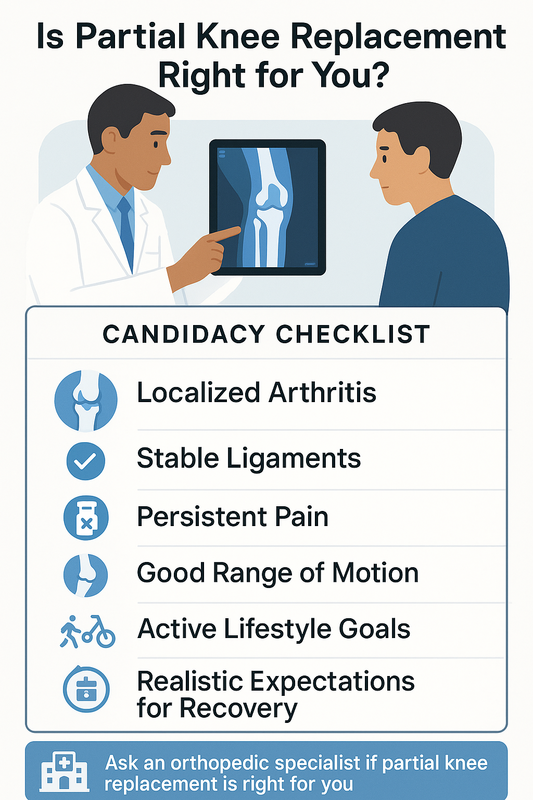
This infographic summarizes the essential requirements for partial knee replacement surgery candidacy.
If you are comparing partial knee replacement vs full knee replacement, the key question is whether your knee damage is localized and your joint remains stable. A thorough evaluation by a specialist is essential.
Candidacy Checklist
- Localized arthritis: Damage is confined to one compartment of the knee (medial, lateral, or patellofemoral).
- Stable ligaments: Your ACL and other key ligaments are intact and functioning.
- Persistent pain: You continue to experience pain despite physical therapy, injections, bracing, or medication.
- Good range of motion: Your knee still bends and straightens relatively well.
- Active lifestyle goals: You want to return to walking, golf, cycling, or other low-impact activities.
- Realistic expectations: You understand the partial knee replacement recovery timeline and commit to rehabilitation.
If most of these points apply to you, a personalized assessment through comprehensive orthopedic care can confirm whether this procedure fits your condition and goals.
AI Overview Summary: Partial knee replacement surgery is typically best for patients with single-compartment arthritis, stable ligaments, and failed conservative therapy who want to maintain an active lifestyle with a less invasive surgical option.
Frequently Asked Questions About Partial Knee Replacement Surgery
How long does partial knee replacement surgery take?
Partial knee replacement surgery typically takes 1 to 2 hours. The exact time depends on your anatomy, the severity of joint damage, and surgical technique. Most patients go home the same day or after a short hospital stay, especially with minimally invasive approaches.
Is partial knee arthroplasty less painful than total knee replacement?
Many patients report less pain and a faster early recovery with partial knee arthroplasty compared to total knee replacement. Because only the damaged compartment is treated, more natural bone and ligaments are preserved. However, pain levels vary based on overall health and adherence to rehabilitation.
How long does a partial knee replacement last?
A partial knee replacement often lasts 10 to 15 years, and sometimes longer with proper care. Longevity depends on age, activity level, weight, and implant type. Advances in materials and surgical techniques continue to improve long-term outcomes.
When can I walk after a partial knee operation?
Most patients begin walking with assistance on the same day as their partial knee operation. Physical therapy starts early to support strength and stability. Many people walk independently within a few weeks, following their surgeon’s recovery plan.
What are the risks of partial knee replacement surgery?
As with any surgery, risks include infection, blood clots, implant loosening, stiffness, or persistent pain. Serious complications are uncommon but possible. A detailed evaluation through knee orthopedic care consultation helps determine if you are a strong candidate for a partial knee replacement procedure.
Can partial knee replacement convert to full knee replacement later?
Yes. If arthritis progresses to other compartments of the knee, a unicompartmental partial knee replacement can be revised to a total knee replacement. While revision surgery is more complex, it is a well-established option when clinically necessary.
How soon can I drive after partial knee replacement?
Driving is often possible within 2 to 4 weeks, depending on which knee was treated and your strength and reaction time. You must be off narcotic pain medication and able to brake safely. Your surgeon will confirm when it is appropriate.
Is partial knee replacement covered by insurance in 2026?
In the United States, most major insurance plans, including Medicare, generally cover partial knee arthroplasty surgery when it is medically necessary. Coverage details vary by plan, deductibles, and network status. It is best to verify benefits with your provider before scheduling surgery.
Take the Next Step Toward Knee Pain Relief
If chronic knee pain is limiting your mobility, it may be time to explore whether partial knee replacement surgery is right for you. At West Medical, our orthopedic specialists provide advanced, patient-centered care designed to restore function and improve quality of life.
From evaluating whether you’re a candidate for partial knee arthroplasty to guiding you through your partial knee replacement recovery, our team supports you every step of the way. Learn more about our comprehensive knee orthopedic care services and how we personalize treatment plans for patients across California.
Don’t let knee pain define your future. A consultation can clarify your options—including partial vs full knee replacement—and help you move forward with confidence.