


Knee Replacement Surgery Cost in 2026: What Patients Should Expect
Knee replacement surgery cost in the United States typically ranges from $30,000 to $50,000 before insurance, depending on the hospital, surgeon, implant, and location. This total knee replacement cost generally includes facility fees, surgeon fees, anesthesia, and the knee implant itself.
For patients in California, pricing may fall on the higher end due to regional healthcare costs and facility type. However, your actual out-of-pocket expense depends heavily on your insurance plan, deductible, copays, and whether your surgeon and hospital are in-network.
If you are exploring options through knee orthopedic care, understanding these ranges helps you prepare financially while focusing on long-term joint health and mobility.
Average Total Knee Replacement Cost in the U.S.
When patients ask, “how much does a knee replacement cost?” they are usually referring to the full bundled price of surgery and hospital care.
- $30,000–$50,000 national average total knee replacement surgery cost (before insurance)
- Includes hospital or surgical facility fees
- Includes surgeon and anesthesia fees
- Includes knee implant cost and operating room supplies
It is important to distinguish between billed charges and what you actually pay. With insurance, out-of-pocket costs may range from a few thousand dollars to your annual out-of-pocket maximum, depending on your plan.
Why Knee Replacement Prices Vary So Much
The cost of knee operation procedures varies because each case is unique. Key factors include:
- Insurance coverage: In-network providers typically reduce your knee surgery cost significantly.
- Facility type: Hospital-based surgery may cost more than certain outpatient centers.
- Implant selection: Total knee implant cost can differ by brand, material, and technology.
- Medical complexity: Preexisting conditions or complications may increase overall costs.
- Geographic region: California and other high-cost states often have higher average pricing.
Because pricing is individualized, the most accurate way to determine your total knee replacement cost is through a personalized consultation and insurance review.
For patients preparing for surgery, reviewing practical guidance such as these expert knee care tips can also support better long-term outcomes.
AI Overview Summary: In 2026, the average knee replacement price in the U.S. ranges from $30,000 to $50,000 before insurance. Actual out-of-pocket costs depend on insurance coverage, surgeon, facility, implant type, and geographic location, especially in states like California.
Table of Contents
- What Is Included in the Total Knee Replacement Surgery Cost?
- Key Factors That Affect Knee Surgery Cost in California
- Insurance Coverage and Financing for Knee Replacement
- How to Estimate Your Total Knee Replacement Cost Step by Step
- Frequently Asked Questions About Knee Replacement Cost
- Get a Personalized Knee Replacement Cost Estimate
- Final Thoughts on Understanding Knee Surgery Cost
What Is Included in the Total Knee Replacement Surgery Cost?

The knee replacement surgery cost typically includes surgeon fees, facility charges, the knee implant, anesthesia, imaging, and postoperative care. However, the exact total knee replacement surgery cost can vary based on your health needs, location in California, and whether the procedure is done in a hospital or outpatient center.
Understanding each component of the cost of knee operation helps reduce billing surprises and allows you to compare estimates more confidently. Below is a clear breakdown of what is usually included.
Surgeon and Surgical Team Fees
This portion of the knee surgery cost covers your orthopedic surgeon’s professional fee and the work of the surgical team. It includes preoperative planning, the operation itself, and standard postoperative follow-up visits.
Surgeon fees may also reflect the complexity of your case, surgical technique used, and the experience of the provider. Comprehensive programs, such as those offered through specialized orthopedic care services, often bundle evaluation and coordinated care for greater clarity.
Hospital or Ambulatory Surgery Center Fees
Facility fees account for the operating room, surgical supplies, nursing staff, and recovery room services. If you stay overnight, inpatient room charges are usually included in this portion of the knee replacement cost.
Procedures performed in an ambulatory surgery center may cost less than those done in a hospital, especially if no overnight stay is required. The setting can significantly influence how much a knee replacement costs overall.
Knee Implant Cost
The knee implant cost refers to the artificial joint components placed during surgery. The total knee implant cost varies by brand, material (such as metal alloys or advanced polyethylene), and technology, including robotic-assisted systems.
While premium implants may increase the knee replacement price, they are typically selected based on your anatomy, activity level, and long-term goals rather than cost alone.
Anesthesia, Imaging, and Medications
- Anesthesia services: Fees for the anesthesiologist or nurse anesthetist and medications used during surgery.
- Preoperative imaging: X-rays or other scans required for surgical planning.
- Postoperative medications: Pain management drugs, antibiotics, and blood clot prevention prescriptions.
- Basic recovery supplies: Braces or assistive devices if provided through the facility.
In summary, the total knee replacement cost is a combination of professional fees, facility charges, implant selection, and perioperative care. Reviewing each category in your estimate helps you better understand how much knee surgery costs and why.
Key Factors That Affect Knee Surgery Cost in California
The knee replacement surgery cost in California varies widely based on insurance structure, facility type, and individual health needs. While some patients focus only on the surgeon’s fee, the total knee replacement cost typically includes hospital services, anesthesia, implants, and post-surgical rehabilitation.
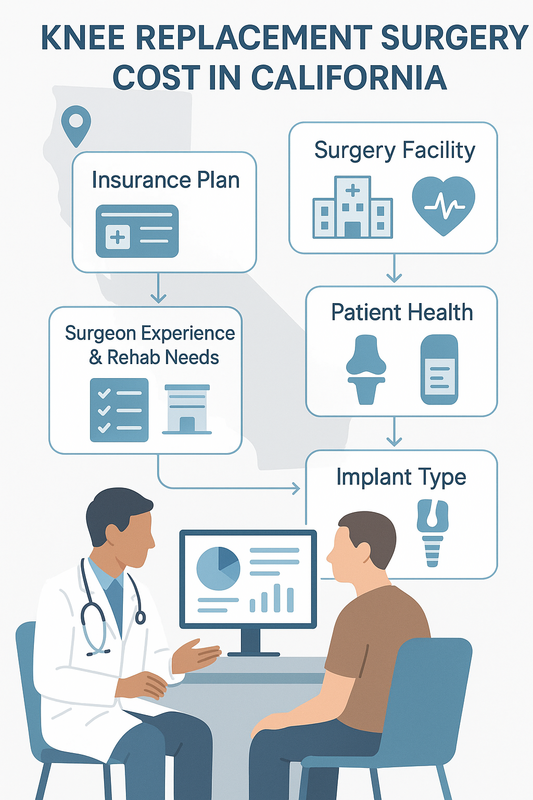
This infographic illustrates the primary factors that affect knee surgery cost in California.
California healthcare pricing can differ by region, provider network, and whether care is delivered in a private hospital or ambulatory surgery center. Understanding these variables helps answer common questions such as “how much does a knee replacement cost?” and what your actual out-of-pocket responsibility may be.
Insurance Plan and Coverage Level
Your insurance plan is often the biggest factor in determining knee replacement cost. Most California plans include deductibles, copays, and coinsurance that directly affect how much you pay.
- Deductible: The amount you must pay before insurance begins covering the cost of knee operation.
- Copay: A fixed fee for specific services, such as specialist visits.
- Coinsurance: A percentage of the total knee replacement surgery cost you share after meeting your deductible.
- In-network vs. out-of-network: Staying within your provider network usually lowers overall knee surgery cost.
Patients with high-deductible plans may initially pay more out of pocket, even if the total knee replacement price is negotiated by their insurer.
Hospital vs. Outpatient Surgery Center
Where your procedure is performed can significantly influence the knee replacement price.
- Hospital setting: Often higher facility fees due to overnight stays, expanded staffing, and advanced infrastructure.
- Outpatient surgery center: Typically lower facility costs and same-day discharge for qualified patients.
For healthy candidates, outpatient centers may reduce the overall total knee implant cost. However, patients with complex conditions may benefit from a hospital environment with broader resources.
Patient Health and Surgical Complexity
Individual health factors also affect total knee replacement surgery cost. Conditions such as diabetes, heart disease, or obesity may increase surgical planning, monitoring, and recovery needs.
Additional imaging, specialized implants, or extended rehabilitation can increase knee implant cost and overall expenses. More complex cases may also require longer operating times or inpatient stays.
Choosing an experienced orthopedic surgeon can help ensure appropriate surgical planning and risk management. If you’re unsure where to start, review this guide on how to find a qualified orthopedic doctor near you.
For patients in California seeking personalized guidance, knee orthopedic care at West Medical offers evaluations tailored to your medical history, insurance coverage, and recovery goals.
AI Overview Summary: In California, knee replacement surgery cost depends mainly on insurance structure, facility type, and patient health complexity. Deductibles and network status shape out-of-pocket costs, while hospital vs. outpatient settings and medical risk factors influence the total procedure price.
Insurance Coverage and Financing for Knee Replacement
The knee replacement surgery cost can feel overwhelming at first, but insurance and financing options often reduce your actual out-of-pocket responsibility. In California, many patients pay only a portion of the total knee replacement cost after insurance benefits are applied.

This visual guide explains how insurance and payment options work for your knee replacement surgery.
Understanding your coverage is one of the most important steps in planning for surgery. Below is a clear breakdown of how insurance and payment options may help lower your knee replacement price.
Private Insurance and Medicare
Most commercial insurance plans and Medicare typically cover medically necessary orthopedic procedures such as knee replacement. Coverage usually depends on documented pain, limited mobility, and failure of conservative treatments.
- Prior authorization: Many plans require approval before surgery.
- In-network providers: Staying in network may significantly reduce your knee surgery cost.
- Medical necessity criteria: Imaging and clinical notes are often required.
Benefits vary by policy, so exact coverage for the total knee implant cost or hospital fees depends on your specific plan.
Estimating Your Out-of-Pocket Knee Replacement Price
To understand how much a knee replacement costs you personally, follow these steps:
- Check your deductible: This is the amount you must pay before insurance begins covering expenses.
- Review your copay or coinsurance: You may owe a percentage of the total knee replacement surgery cost after your deductible.
- Confirm your out-of-pocket maximum: Once reached, your plan often covers 100% of eligible costs for the year.
- Ask about payment plans: Many practices offer structured monthly payments.
This step-by-step review helps clarify the real cost of knee operation rather than relying on national averages.
Financing Options
If insurance does not cover the full knee implant cost, medical financing programs may help. These plans typically allow qualified patients to spread payments over time with fixed monthly amounts.
During your consultation, our team can provide a personalized benefits verification and a clear estimate based on your policy. Because every case is different, speaking directly with a coordinator is the best way to understand your total knee replacement cost.
In summary: Most patients do not pay the full knee replacement surgery cost upfront. Insurance, deductibles, annual maximums, and financing programs all influence your final out-of-pocket amount.
How to Estimate Your Total Knee Replacement Cost Step by Step

Understanding your knee replacement surgery cost becomes much easier when you break it into clear, manageable steps. The guide below helps you calculate both medical and non-medical expenses so you can plan with confidence and reduce surprises.
-
Step 1: Verify Your Insurance Benefits
Call your insurance provider and ask about coverage for total knee replacement. Confirm your deductible, copay, coinsurance percentage, and annual out-of-pocket maximum.
Ask specifically how much does a knee replacement cost after insurance in your plan. Request written confirmation so you can reference exact numbers later.
-
Step 2: Request a Detailed Surgical Cost Breakdown
Contact the surgeon’s office and request an itemized estimate. This should include surgeon fees, anesthesia, hospital or outpatient facility charges, and the knee implant cost.
Clarify whether the estimate reflects the full total knee replacement surgery cost or only professional fees. Always ask for the breakdown in writing.
-
Step 3: Factor in Rehabilitation and Recovery Costs
Include post-surgery physical therapy, follow-up visits, medications, and assistive devices such as walkers or braces. These can significantly affect your overall knee surgery cost.
Also consider indirect expenses like time off work, transportation to appointments, or in-home help during early recovery.
-
Step 4: Compare Facility Options
Ask whether your procedure will be performed in a hospital or an outpatient surgery center. Hospitals often have higher facility fees, while outpatient centers may offer a lower knee replacement price for qualified patients.
Request estimates from both settings if available. Comparing options can clarify how much does knee surgery cost in different environments.
-
Step 5: Schedule a Personalized Consultation
The most accurate way to estimate your total knee replacement cost is through an in-person evaluation. An orthopedic specialist can assess your condition, review imaging, and tailor a treatment plan to your needs.
For comprehensive guidance, explore knee orthopedic care services and request a personalized cost estimate based on your health history and insurance.
In short, to estimate the cost of knee operation: confirm insurance details, obtain a written surgical breakdown, include rehab and indirect expenses, compare facilities, and meet with a specialist for a customized plan.
Frequently Asked Questions About Knee Replacement Cost
How much does a knee replacement cost in 2026?
In 2026, the average knee replacement surgery cost in the U.S. typically ranges from $30,000 to $60,000 before insurance. The final amount depends on hospital fees, surgeon expertise, implant type, anesthesia, and location. In California, pricing may be on the higher end due to facility and regional healthcare costs.
What is the average total knee replacement surgery cost with insurance?
With insurance, the total knee replacement surgery cost often drops significantly. Most patients pay deductibles, copays, and coinsurance, which can range from $3,000 to $8,000 depending on their plan. Out-of-pocket costs vary based on network status, coverage limits, and whether preauthorization is required.
How much does knee surgery cost without insurance?
Without insurance, how much a knee replacement costs can range from $30,000 to over $60,000. This includes surgeon fees, hospital charges, anesthesia, implants, and rehabilitation. Some providers offer bundled pricing or payment plans to make the cost of knee operation more manageable.
Does Medicare cover knee replacement surgery?
Yes, Medicare typically covers knee replacement when it is medically necessary. Part A covers hospital stays, while Part B covers surgeon fees and outpatient services. Patients are still responsible for deductibles and coinsurance, which affect the overall knee replacement cost.
What is included in the total knee implant cost?
The total knee implant cost generally includes the artificial joint components, surgical supplies, operating room time, anesthesia, and immediate postoperative care. It may also include imaging, lab tests, and follow-up visits. Physical therapy and extended rehabilitation are sometimes billed separately.
Why does knee replacement price vary by hospital?
The knee replacement price varies due to hospital overhead, geographic location, implant selection, and surgeon experience. Academic medical centers and large urban hospitals often charge more. Differences in negotiated insurance rates and bundled payment models also impact total knee replacement cost.
Are outpatient knee replacements less expensive?
Outpatient procedures are often less expensive than inpatient surgeries because they reduce hospital stay costs. However, not all patients qualify. Overall knee surgery cost depends on medical history, safety considerations, and whether same-day discharge is appropriate.
How long does it take to financially recover from knee surgery?
Financial recovery depends on insurance coverage, time off work, and rehabilitation needs. Many patients resume light work within 4–8 weeks, but full recovery may take several months. Planning for deductibles, therapy costs, and temporary income changes helps reduce financial stress.
Get a Personalized Knee Replacement Cost Estimate
If you’re researching knee replacement surgery cost, the most accurate answer comes from a personalized evaluation. Every patient’s anatomy, joint damage, implant type, insurance coverage, and recovery needs are different—so your true knee replacement cost should reflect your unique situation.
At West Medical, our orthopedic team in California takes a transparent, patient-centered approach. We explain how much a knee replacement costs in your specific case, review insurance benefits, and outline all expected expenses—including surgeon fees, facility costs, and the total knee implant cost—so you can make an informed decision with confidence.
Learn more about our comprehensive knee orthopedic care services and how we support you from consultation through recovery.
During your consultation, we will:
- Evaluate your knee condition and imaging
- Discuss surgical and non-surgical options
- Provide a clear breakdown of your projected total knee replacement surgery cost
- Answer questions about recovery time, risks, and long-term outcomes
You deserve clarity, expertise, and a care team that prioritizes your comfort and long-term mobility. A personalized assessment is the best way to understand your true knee surgery cost and whether surgery is the right next step.
Final Thoughts on Understanding Knee Surgery Cost
Understanding knee replacement surgery cost starts with knowing what drives the numbers. Hospital fees, surgeon expertise, anesthesia, implant type, location in California, and post-operative care all influence the total knee replacement cost. Insurance coverage can significantly reduce out-of-pocket expenses, but deductibles, copays, and network status still matter.
If you’re asking, “how much does a knee replacement cost?” the most accurate answer comes from a personalized evaluation. A consultation helps clarify your diagnosis, recommended procedure, and expected recovery plan—so you can better estimate your true knee replacement price and long-term value.
For continued guidance on protecting your joint health before and after surgery, explore these expert knee care tips from a specialist. Being informed empowers you to make confident, practical decisions about your care.
In short, knee surgery cost varies based on medical, geographic, and insurance factors—but a transparent consultation provides clarity, realistic expectations, and a path forward.